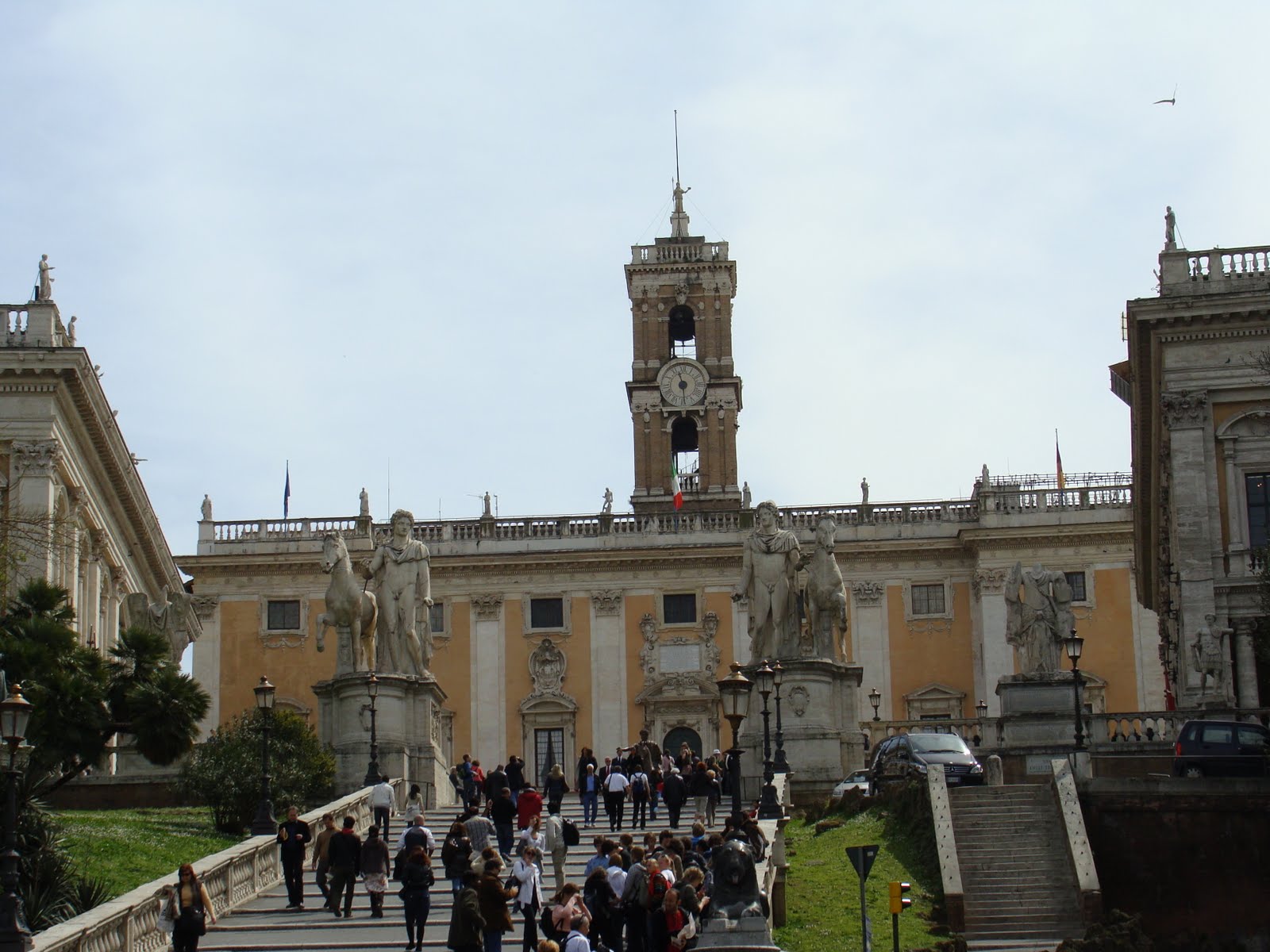
The Capitoline Hill was the center of the ancient Roman government and religion, functioning not only a citadel on one of its two summits, but also the location of the most important temple in Roman, the Temple of Jupiter Optimus Maximus. Nowadays, it is a centerpiece of the architecture of the Renaissance, designed by Michelangelo and completed bit by bit over several centuries.

The Church of Santa Maria Aracoeli, or "Altar of Heaven" surmounts the peak of the Capitoline that once held the Arx, or citadel of ancient Rome. This was the location of the famous geese sacred to Juno, who warned the Romans of a night attack up the steep slopes of the hill by Gallic raiders. The temple on the Arx was dedicated to Juno Moneta, or Juno of the Watch; money was minted in the precincts of this temple, hence our English words "money" and "monetary."

But the real highlight of the Capitoline is the great Piazza Campidoglio, designed by Michelangelo and flanked by the
Capitoline Museums on the left and right and the City Hall of Rome built on the foundations of the Tabularium, the hall of records of Rome.

The square is irregular, so Michelangelo gently rotated the new building on the left, the Palazzo Nuovo to create an optical illusion that the piazza was perfectly square.

The optical illusion works, coupled with the elaborate oval pavement of the piazza.

Above is the statue of Marcus Aurelius, who serves as the focal point of the center of the piazza; saved from destruction because it was incorrectly attributed to be Constantine, the first Christian Roman emperor, it became one of several Roman statues placed in the piazza, creating a link from ancient Rome to the Renaissance Rome. What you see here is actually a reproduction; the real one is in the Capitoline Museums.

Here is a statue of a river god, one of two ancient Roman river god statues now placed on the Campidoglio.

This is the famous Dioscuri statue, salvaged from ancient Rome and mounted at the top of the stairs along with its mate on the other side.

The picture above illustrates just how tall of a hill the higher of the two summits of the Capitoline really is.

The Capitoline Hill is still a sleepy enclave in the center of the city, made up of a lush park and winding footpaths up to the summit where the
Temple of Jupiter once stood.

This is the infamous Tarpeian Rock, or close to it, as the area is prone to landslide so much of the area was blocked off, where traitors were thrown to their death. The rock is named after the treacherous Tarpeia, who was promised by the Samnites, Rome's enemies, gold bracelets if she opened the gates of the citadel. After she committed the act, the Samnites crushed her to death under their shields, which were decorated with gold bracelets. A great example of your typical ironic Roman morality tale.

This mysterious cut in the rock is a mystery to me; it does illustrate how rugged and shear of a rock formation the Capitoline Hill is. Here is an
aerial view of this wonderful cultural site.
 The Campo Marzio, or Campus Martius in ancient Latin, is the heart of the city of Rome today, much as it had been the ceremonial heart of the city for centuries during the Roman Empire. Originally a grassy meadow where military exercises were conducted, the area filled with temples and other buildings as space ran out in the forums.
 It is amazing to walk these streets, as old Roman columns literally pop out of the walls in this area of Rome. One can only imagine what else lies underneath the modern day buildings. Certainly dozens of temples remain buried. I once had dinner in the cellar of one of the buildings in the Campo Marzio, and there were porphyry columns sticking out of the walls of the basement.
 One of the stranger monuments in Rome is the so-called "Pasquino," which during Papal Rome served as a sort of "free-speech zone" in a time when speaking against the government landed a person in jail. The joke was that the statue was speaking the political commentary, so it continues to this day.
 As you can see, people still plaster political messages on the base of the statue, as they have for centuries.