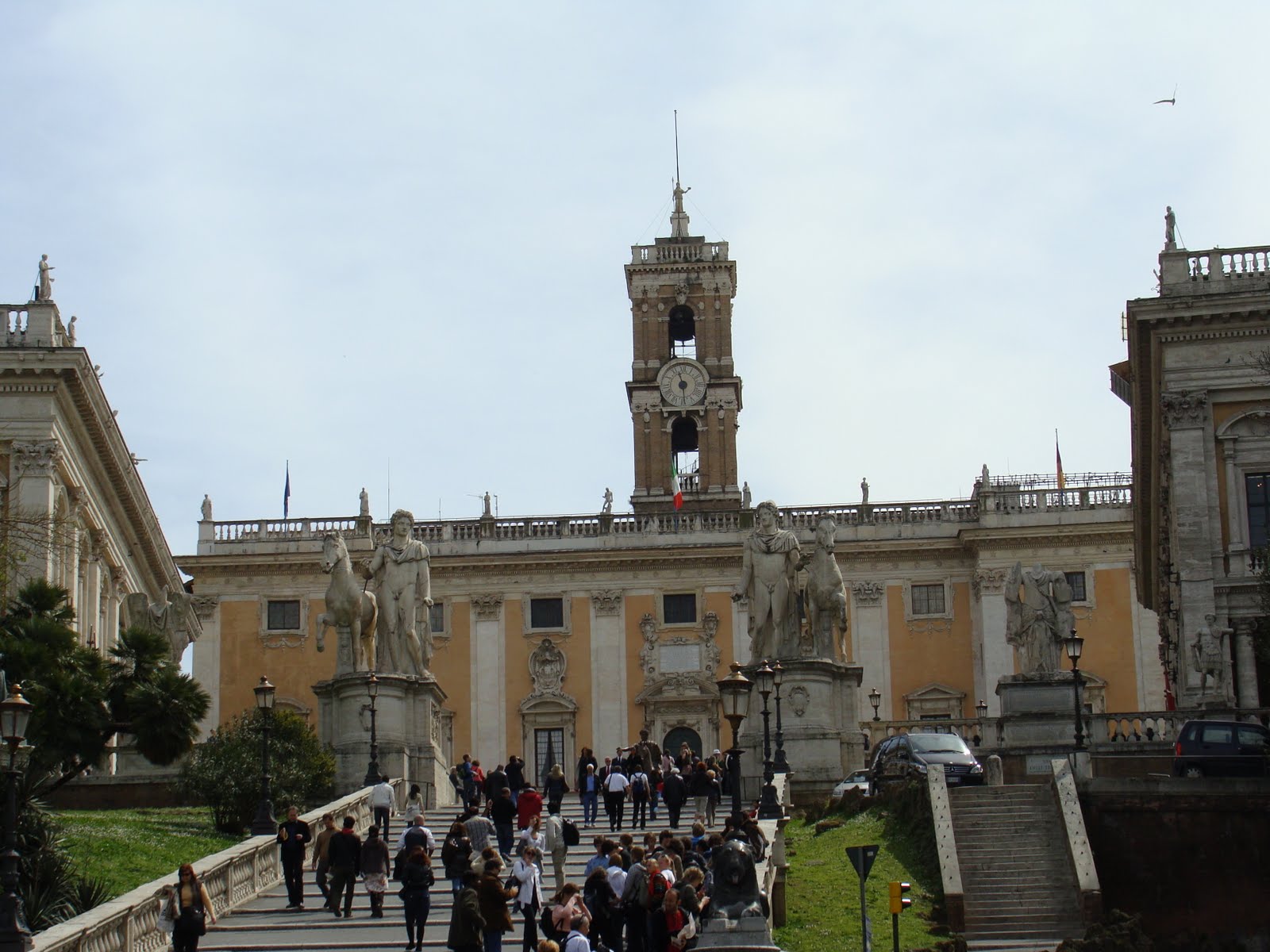
The Capitoline Hill was the center of the ancient Roman government and religion, functioning not only a citadel on one of its two summits, but also the location of the most important temple in Roman, the Temple of Jupiter Optimus Maximus. Nowadays, it is a centerpiece of the architecture of the Renaissance, designed by Michelangelo and completed bit by bit over several centuries.

The Church of Santa Maria Aracoeli, or "Altar of Heaven" surmounts the peak of the Capitoline that once held the Arx, or citadel of ancient Rome. This was the location of the famous geese sacred to Juno, who warned the Romans of a night attack up the steep slopes of the hill by Gallic raiders. The temple on the Arx was dedicated to Juno Moneta, or Juno of the Watch; money was minted in the precincts of this temple, hence our English words "money" and "monetary."

But the real highlight of the Capitoline is the great Piazza Campidoglio, designed by Michelangelo and flanked by the
Capitoline Museums on the left and right and the City Hall of Rome built on the foundations of the Tabularium, the hall of records of Rome.

The square is irregular, so Michelangelo gently rotated the new building on the left, the Palazzo Nuovo to create an optical illusion that the piazza was perfectly square.

The optical illusion works, coupled with the elaborate oval pavement of the piazza.

Above is the statue of Marcus Aurelius, who serves as the focal point of the center of the piazza; saved from destruction because it was incorrectly attributed to be Constantine, the first Christian Roman emperor, it became one of several Roman statues placed in the piazza, creating a link from ancient Rome to the Renaissance Rome. What you see here is actually a reproduction; the real one is in the Capitoline Museums.

Here is a statue of a river god, one of two ancient Roman river god statues now placed on the Campidoglio.

This is the famous Dioscuri statue, salvaged from ancient Rome and mounted at the top of the stairs along with its mate on the other side.

The picture above illustrates just how tall of a hill the higher of the two summits of the Capitoline really is.

The Capitoline Hill is still a sleepy enclave in the center of the city, made up of a lush park and winding footpaths up to the summit where the
Temple of Jupiter once stood.

This is the infamous Tarpeian Rock, or close to it, as the area is prone to landslide so much of the area was blocked off, where traitors were thrown to their death. The rock is named after the treacherous Tarpeia, who was promised by the Samnites, Rome's enemies, gold bracelets if she opened the gates of the citadel. After she committed the act, the Samnites crushed her to death under their shields, which were decorated with gold bracelets. A great example of your typical ironic Roman morality tale.

This mysterious cut in the rock is a mystery to me; it does illustrate how rugged and shear of a rock formation the Capitoline Hill is. Here is an
aerial view of this wonderful cultural site.
 Sant Andrea al Quirinale is located high on the Quirinal Hill, on the Via del Quirinale, on a rectangular site with its long side facing the major avenue. Now major avenue in Rome means two lanes and sidewalks, mind you. It is the masterpiece of church design of Gian Lorenzo Bernini, who attended the church, claiming it was his only perfect work. The genius of his design is his creation of an optical illusion of a normally proportioned church sitting in what is in reality an awkward location.
 The interior is stunning, and greeting the visitor straight ahead is a miraculous vision of the apostle Andrew being borne into Heaven in a blaze of stuccoed glory.
 Above, you can see his martyrdom in paint, where the apostle continued to preach on an X-shaped cross even after being pardoned by the Roman governor. Below is a close-up of the stuccoed figure of St. Andrew.
 Below is the hidden window that Bernini used to light the altar; he always hid his light source to give the impression that Heavenly rays were falling on the miraculous vision.
 I don't like the advertisements, but this website has great drawings of the interior, which is difficult to capture on a camera.